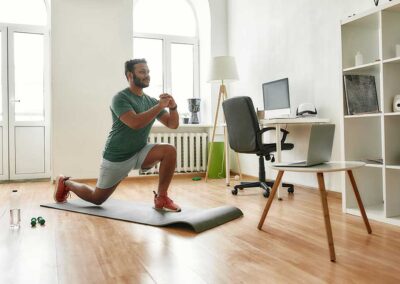
With post-pandemic working patterns potentially leading to employees sitting more and moving less, we look at ways employers can help to boost employee fitness.
With too much sitting being dubbed as ‘the new smoking’ now is a great opportunity for employers to be kickstarting conversations around active lifestyles, commutes and ways to build fitness and health more generally. Below are five ideas you can use to help you get started.
Embrace awareness campaigns and charity events
A popular awareness event is Cycle to Work Day, which encourages people to get out riding, whether for commuting or pleasure. It enables you to sign up to a ‘Love to ride’ online community and has prize draws you can enter.
Promoting and publicising this could be a good starting point when trying to change sedentary habits. However, with Cycle to Work Day in particular do bear in mind that Cyclescheme is a provider of salary sacrifice-based cycle leasing schemes. So, to an extent, it is also using the day as a vehicle to promote cycle-to-work schemes as an employee benefit.
More general awareness days you may want to add to the health promotion calendar include On Your Feet Britain, National Walking Month, National Fitness Day, Move More Month and Walk to work day.
You can also be proactive about promoting exercise-based charitable activities such as charity walks, runs or bike rides. This could be through supporting individuals (perhaps through match funding) or whole teams, perhaps with at-work fundraising events or activities. You could also consider nominating charities for particular support during a 12-month period.
Encourage year-round active commuting and working
Encouraging staff to look after their fitness is something that needs to be drip-fed all year round rather than just for one day or a month. If walking or cycling to work isn’t an option for some employees, perhaps you could encourage them to get off a stop earlier and walk the rest of the way, or park the car park further away.
Equally, you can also encourage people to use the stairs rather than the lift, consider investing in sit/stand desks, introduce standing (or even walking) meetings, or simply try to encourage people to get up more from their desks and talk to colleagues rather than sending an email.
Getting out at lunchtime for a walk and a proper recharge is another idea, and something staff can do who work from home for part or all of the week.
Ramp up your health/exercise-based benefits or tools
As well as encouraging behavioural change, look at what tools or benefits you either already have or can introduce that might encourage employees to become more active. One of these, of course, could be a cycle-to-work scheme. As we’ve highlighted, Cycle to Work Day is, in part, is a a promotional tool for such workplace-based schemes.
They can be a tax-efficient way for employees to get access to a top-of-the-range bicycle and so kickstart a healthier lifestyle. However, it is important to explain carefully to employees the financial commitment they are signing up to, especially what happens at the end of the leasing period. This is to ensure employees fully appreciate they are leasing not ‘buying’ the bicycle.
You can also look at offering subsidised access or membership to a gym or even setting up your own gym or exercise facility. Another idea is to run a company competition, such as a ‘step challenge’, where staff can enter in teams and work together to hit a target or to raise money for charity.
Health and wellbeing apps or tools are another way to help encourage behavioural change across staff. These can help with motivation through the use of engaging interfaces and features such as gamification. There are also apps available for free, such as the NHS’s ‘couch to 5K’ which you can signpost staff to as part of your health promotion.
Conduct regular staff health checks
Organisations can promote better health by offering regular staff health checks and assessments. These sorts of interventions are related to cardiovascular conditions and your general overall health.
The benefits of workplace health checks are considerable. Employees are more likely to stay with a firm that offers assessments, reducing staff turnover. They also help staff to feel more valued, and employees tend to like that their employer cares about their wellbeing.
Another benefit of running health checks across staff is their ability to detect any underlying conditions that don’t have any symptoms yet. Employees on these schemes often discover conditions they would never have known about without a workplace check-up. Because of this, they can access potentially life-saving treatment.
Encourage at-desk exercising
For those of us with desk-based roles, it is not hard to understand the benefits of stretching and moving while at your desk, taking breaks and getting up periodically.
It is possible to take this to the next level with at-desk stretching and exercising. The NHS has some sitting and stretching exercises here, for example, including thigh stretches and chair twists. There are also lots of exercises available online (often with videos attached) that you can utilise and share with staff. With all these exercises, it is important to check it is safe to do them within the constraints of your desk set-up.
Signpost to community and NHS resources
As well as your internal health promotion activity, it is a good idea to promote and advertise any local or online NHS health campaigns or resources.
This can be, as already highlighted, sitting exercises or tapping into exercise videos, or making use of local physiotherapy or rehabilitation resources. The NHS also has good general fitness and exercise guidelines here. Another option is to consider linking up with local groups, charities or organisations, perhaps a local gym or walking group.
Summary
We all know there are so many benefits to moving more and sitting less. The challenge in our busy and often overly sedentary working lives is changing our behaviours, and then sustaining that lifestyle change.
Employers have a real opportunity to make a difference in this space, both day-to-day within the working environment but also out in their local communities.
Ref: WPW0231 This information was published August 2022.